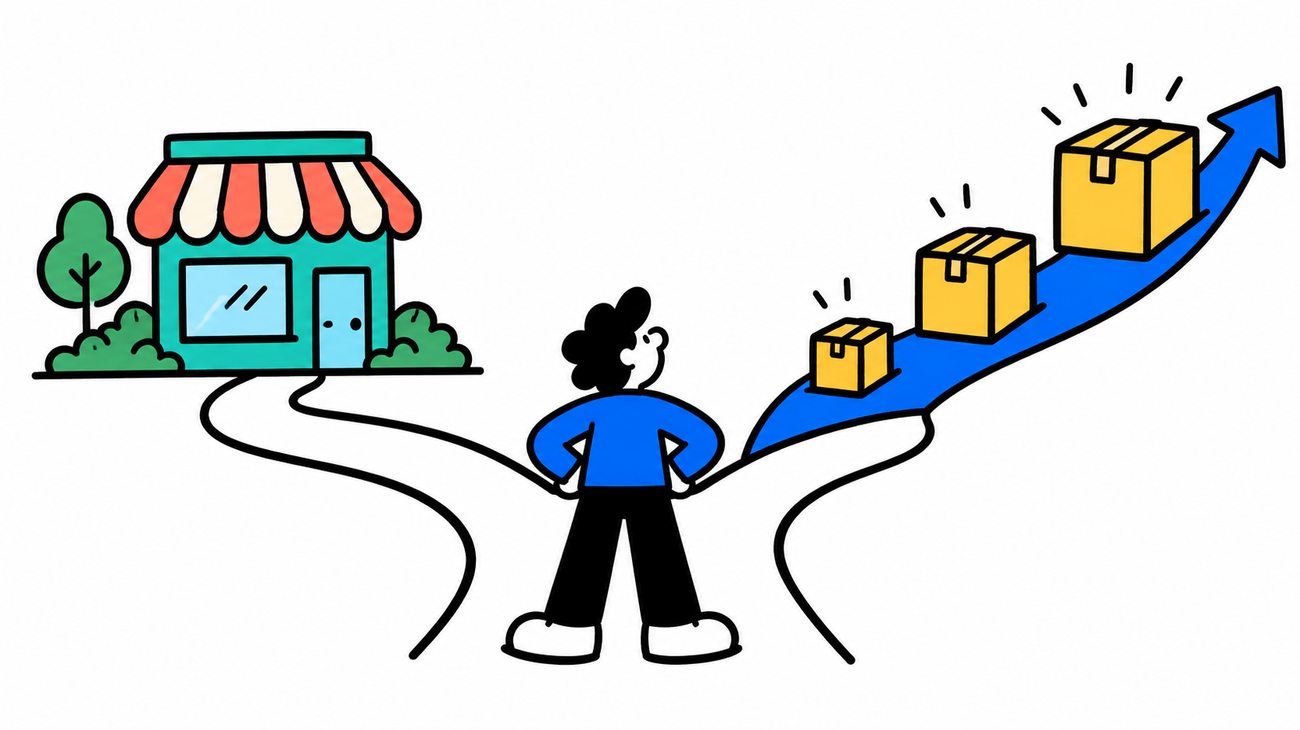
A startup is built to grow fast in a large market. A traditional small business is usually built to earn a profit, pay its owners, and grow at a pace it can fund.
That is the practical difference in the startup vs small business debate. But the labels overlap. A startup can also be a small business under government size rules. And a small business can grow fast, sell worldwide, or become worth millions.
The choice matters because it shapes how you raise money, hire people, and measure progress. A company built to pay its owner needs a different plan from one built to spend years chasing a much larger market.
Startup vs Small Business at a Glance
This table compares common approaches. These are patterns, not rules that every company must follow.
| Factor | Startup | Traditional small business |
|---|---|---|
| Main goal | Rapid growth in a large market | Lasting profit and owner income |
| Business model | Often testing how to sell and grow | Often using a proven approach |
| Growth plan | Build a model that can expand fast | Expand as demand and cash allow |
| Funding | Founder cash, sales, angels, or VC | Savings, sales, loans, or partners |
| Profit | May come later; losses need a plan | Often needed sooner to support owners |
| Ownership | Outside equity reduces founder share | Owners often seek to keep control |
| Key measures | Growth, retention, margins, runway | Cash flow, margins, owner pay, debt |
| Long term goal | Large company; often a sale or IPO | Owner income, succession, or sale |
What Makes a Company a Startup
In the high-growth sense used here, a startup is a company designed to reach a large market fast. It may still be testing what customers want, what they will pay, and how to reach them.
Investor and Y Combinator co-founder Paul Graham puts growth at the center of the startup definition. Being new is not enough. Neither is building an app or raising money.
A startup needs both ambition and a workable way to expand. Wanting a million customers does not mean the market exists or that serving them will make money.
Software can make expansion easier because the same product can serve many customers. But startups also make medical devices, consumer products, and factory equipment. Inventory, shipping, and production costs do not rule them out.
The real question is whether the company can reach a much larger market with a model that works at that size.
What Makes a Company a Small Business
Small business has two meanings in this discussion. One is a size category. The other is a common way to build and run a company.
For research, the SBA Office of Advocacy generally uses fewer than 500 employees. Its 2026 small business FAQ reports about 36.2 million U.S. small businesses. They make up 99.9% of businesses and employ 62.3 million people, or 45.9% of private-sector workers. Those figures draw on data from earlier years.
Program eligibility is more specific. SBA size limits can depend on industry, revenue, employee count, and related businesses. Calling yourself a startup does not settle whether you qualify.
In everyday use, a traditional small business often focuses on serving customers, paying its bills, and producing income for its owners. Examples include a repair shop, agency, distributor, or online store.
That does not mean the owner lacks ambition. A company can expand across states or sell worldwide while keeping profit and control at the center of its plan.
How Growth Changes the Business
Picture two founders selling scheduling tools. These are hypothetical examples.
One builds a small software company for a narrow trade. The plan is to earn steady revenue, keep a lean team, and pay the owner. The other targets thousands of firms, hires ahead of sales, and seeks investors to speed up expansion.
Both sell software. Both may count as small businesses. Their goals, spending plans, and funding needs differ.
The same point applies to physical products. A new product company may use shared designs, contract factories, and broad distribution to expand fast. Each unit still costs money to make and ship.
Scale does not mean the next customer costs nothing. It means the business has a practical way to serve a much larger market. Check what happens to costs, staffing, and cash needs as sales grow.
Funding Sets Expectations
A startup can grow with founder savings and customer revenue. It does not need venture capital to earn the label.
When it does raise outside equity, it sells part of the business. Investors expect that stake to rise in value. Venture investors usually need the chance of a large return through a sale or public offering.
That can clash with an owner’s goal of keeping control and taking steady income. Before accepting money, agree on growth plans, future funding, decision rights, and how investors expect to get paid.
Debt creates a different duty: repayment. The SBA lists a reasonable ability to repay among its 7(a) loan requirements. A large market alone does not make a loan affordable.
For a business with cash flow to support borrowing, compare a term loan and a line of credit based on what the money will fund and when it can be repaid.
Profit Still Matters on Both Paths
A startup may lose money while it builds a product or enters a market. That can be planned. It still needs evidence that spending will lead to a sound business.
A traditional small business may also lose money at first. Opening a restaurant, stocking a store, or building a customer base takes cash before it produces cash.
The useful question is how long the company can fund that gap. Runway means how many months its cash can cover its net cash use.
For example, $600,000 in available cash divided by $50,000 in monthly net cash use gives 12 months of runway. That assumes the pace stays the same and no new funding arrives.
Both models should track contribution margin: sales minus the costs that rise with those sales. More sales can deepen a cash problem when each sale loses money before fixed costs.
A profitable startup is still a startup if its model and goals fit. Paying a founder a salary does not change that. And a small business owner can choose to reinvest profit for years.
What Failure Numbers Actually Tell You
Be careful with claims that 90% of startups fail. Without a defined group, time period, and meaning of failure, that number tells you little.
One BLS study of establishments born in March 2013 found that 79.6% remained open after one year, 50.6% after five years, and 34.7% after ten years.
Those are historical survival rates for private-sector establishments, not a failure rate for venture-backed startups. An establishment is generally a business location. One company can have several.
Staying open also does not prove that an owner or investor earned a good return. Closing does not, by itself, tell you how much they lost.
Look at the risks you would carry. Debt, a personal guarantee, a long lease, or money tied up in stock can hurt an owner on either path. Dependence on another funding round adds a separate risk: the money may not arrive.
Choose the Path That Fits Your Goals
Before you borrow, raise equity, or hire ahead of demand, answer five questions:
- What do I want this business to provide: income, long-term ownership, a large exit, or some mix?
- How large is the market I can realistically reach?
- What cash, people, and equipment would I need to double sales?
- How long can the business and my household wait for dependable income?
- Do my funding terms support those goals?
You can change direction. A service firm can build a product. A startup can slow spending and fund growth from sales. Neither move changes its government size category by itself.
Choose a business model you can support with real demand, enough cash, and clear expectations. Then use funding that fits it. A profitable company can serve its owner well without ever fitting a venture fund’s plan.