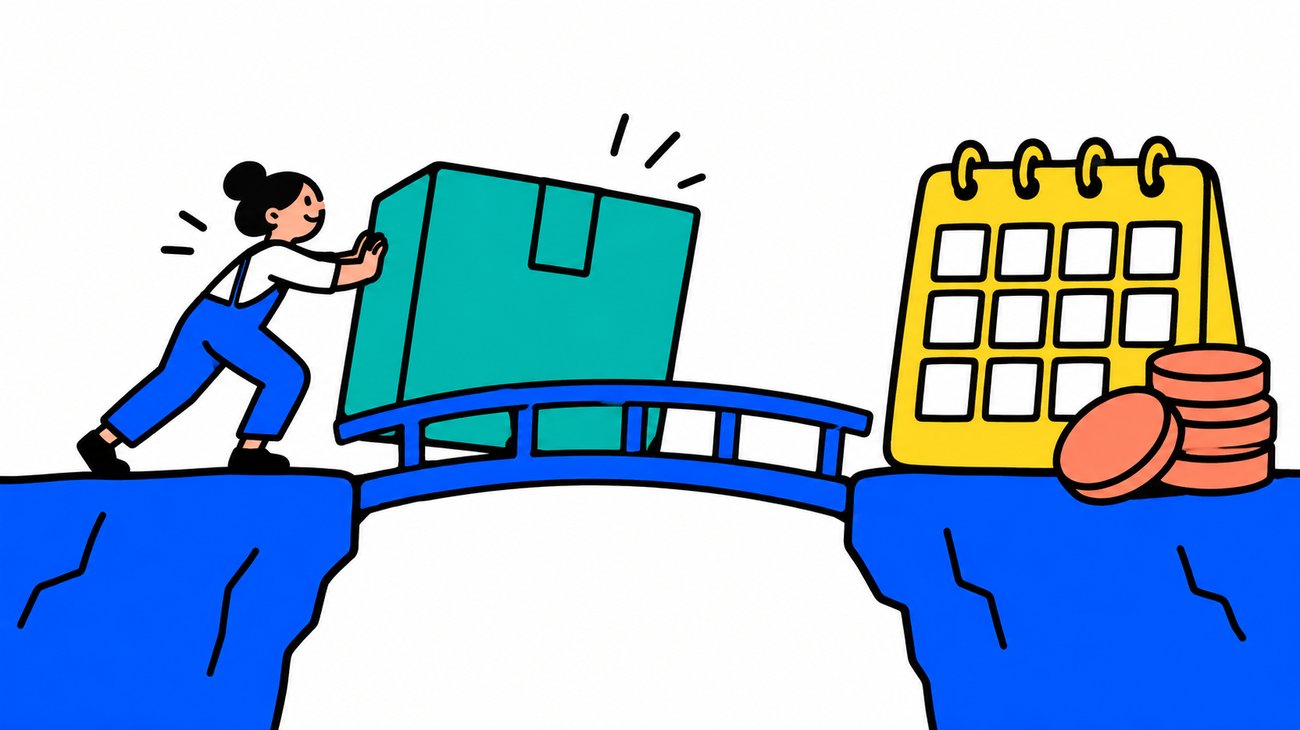
Fundbox offers business funding that can help cover inventory, payroll, or a delayed customer payment. Its line of credit lets you draw money as needed and repay each draw on its own schedule.
The key question is whether your cash will arrive before the payments come due. A loan can bridge a timing gap. It cannot fix a business that loses money on every sale.
Fundbox at a Glance
| Feature | What to know |
|---|---|
| Product covered | Revolving business line of credit |
| Credit limit | Set in your approved offer |
| Repayment terms | Typical terms listed: 12, 24, or 52 weeks. Availability varies by channel and offer. |
| Payments | Each draw has a separate fixed schedule. Confirm payment frequency before drawing. |
| Borrowing cost | Review the fee in dollars and total repayment in your offer. |
| Origination fees | None listed on the current line-of-credit page |
| Early payoff | Remaining fees waived on early payoff |
| Decision and funding | Decision in as little as 3 minutes; funds as soon as the next business day if approved. Neither is guaranteed. |
Sources: Fundbox’s line-of-credit page and business funding page. The product page also describes terms of up to 24 months, but says some terms are available only through embedded partnerships. Do not assume every option is available when you apply directly.
Fundbox’s lending disclosures name First Electronic Bank and Lead Bank as originating banks. They also list separate California lending authority. Check your agreement for the lender on your offer.
How the Line of Credit Works
You receive a credit limit, then choose how much to draw from the amount available. Each draw becomes a separate loan with its own repayment term. Paying down borrowed principal restores room to borrow, subject to your account terms.
For example, a $10,000 draw and a later $5,000 draw create two repayment schedules. Check the combined payment burden before taking the second draw. Available credit is not the same as affordable debt.
Fundbox also offers other financing products through its platform and partners. This review focuses on its line of credit. For a broader comparison, see Small Business Loans.
Who Can Qualify
The public pages reviewed for this article do not state a single current minimum for revenue, time in business, or personal credit score. They also do not establish a universal maximum credit line or starting fee. Treat older figures in lender reviews as a reason to check, not a promise of eligibility or price.
Fundbox says approval depends on a completed application and its lender’s credit and risk policies. Availability can vary by state. Prepare your business and owner details and the financial records requested during the application.
Before authorizing a credit check, confirm whether it is a soft or hard inquiry and when a hard inquiry would occur. Do not assume the initial application and first draw have the same credit-check rules.
What Fundbox Costs
Read the cost of each draw before accepting it. Write down the amount you receive, the fee, the total you repay, and every payment date. Ask for the annual percentage rate, or APR, where available so you can compare the offer with other credit.
A fee of 4.66% over 12 weeks is not a 4.66% annual rate. You repay the money over a short period, and the balance falls as you make payments. Annualizing the cost produces a higher rate.
The example below uses a hypothetical 4.66% fee to show the math. It is not a verified current Fundbox rate or a quote. It assumes 12 equal weekly payments; your actual schedule may differ.
| Item | Illustrative amount |
|---|---|
| Amount borrowed | $10,000 |
| Fee at 4.66% | $466 |
| Total repaid | $10,466 |
| Average weekly payment over 12 weeks | $872.17 |
| Extra sales needed to cover the fee at a 30% contribution margin | $1,553.33 |
The weekly figure is rounded. The last payment would need a small adjustment if the first 11 payments were $872.17.
Can the Extra Sales Cover the Cost
A 30% contribution margin means you keep 30 cents from each extra sales dollar after costs that rise with the sale, such as the product, shipping, and payment processing. In this example, $466 divided by 30% equals about $1,553 in extra sales to cover the financing fee.
That calculation covers only the fee. You still must repay the $10,000 principal and meet your other bills. The sales also need to turn into cash in time for the payments. An order that pays in 90 days will not fund a debit due next week.
Put each payment into your cash-flow forecast. Then test a slower collection week or weaker sales month before you borrow.
Early Payoff and Borrower Risk
Fundbox’s current product page says remaining fees are waived on early payoff. Its business page says there is no early repayment penalty. Ask for a dated payoff amount so you know what you will owe and when the debit will clear.
Review the agreement for a personal guarantee and a security interest or UCC filing. A personal guarantee can make you responsible if the business fails to pay. A security interest gives the lender rights in specified business assets; a UCC filing gives public notice of that claim.
The public product pages reviewed do not establish one guarantee or lien rule for every offer. Confirm your terms, along with late fees, returned-payment charges, automatic debit rules, and credit reporting. If payments are weekly, leave room for a weak week and bank charges from a failed debit.
When Fundbox Is Worth Considering
Fundbox may fit a short cash gap with a clear source of repayment, such as inventory that sells quickly or a customer invoice due soon. Early payoff savings can help when cash arrives ahead of schedule.
It is a weaker fit when you need years to recover the investment, lack a reliable repayment source, or must keep borrowing to cover earlier draws. Compare the total cost and payment schedule with alternatives in Types of Small Business Lenders.
Before drawing, make sure the use of the money earns enough to cover the fee and leaves enough cash to make every payment. Approval tells you what a lender will offer. Your forecast tells you what the business can afford.
Related Posts: Funding Your Business | Debt vs. Equity Funding | Term Loans vs. Lines of Credit |Term Loans for Small Business | Lines of Credit for Small Business