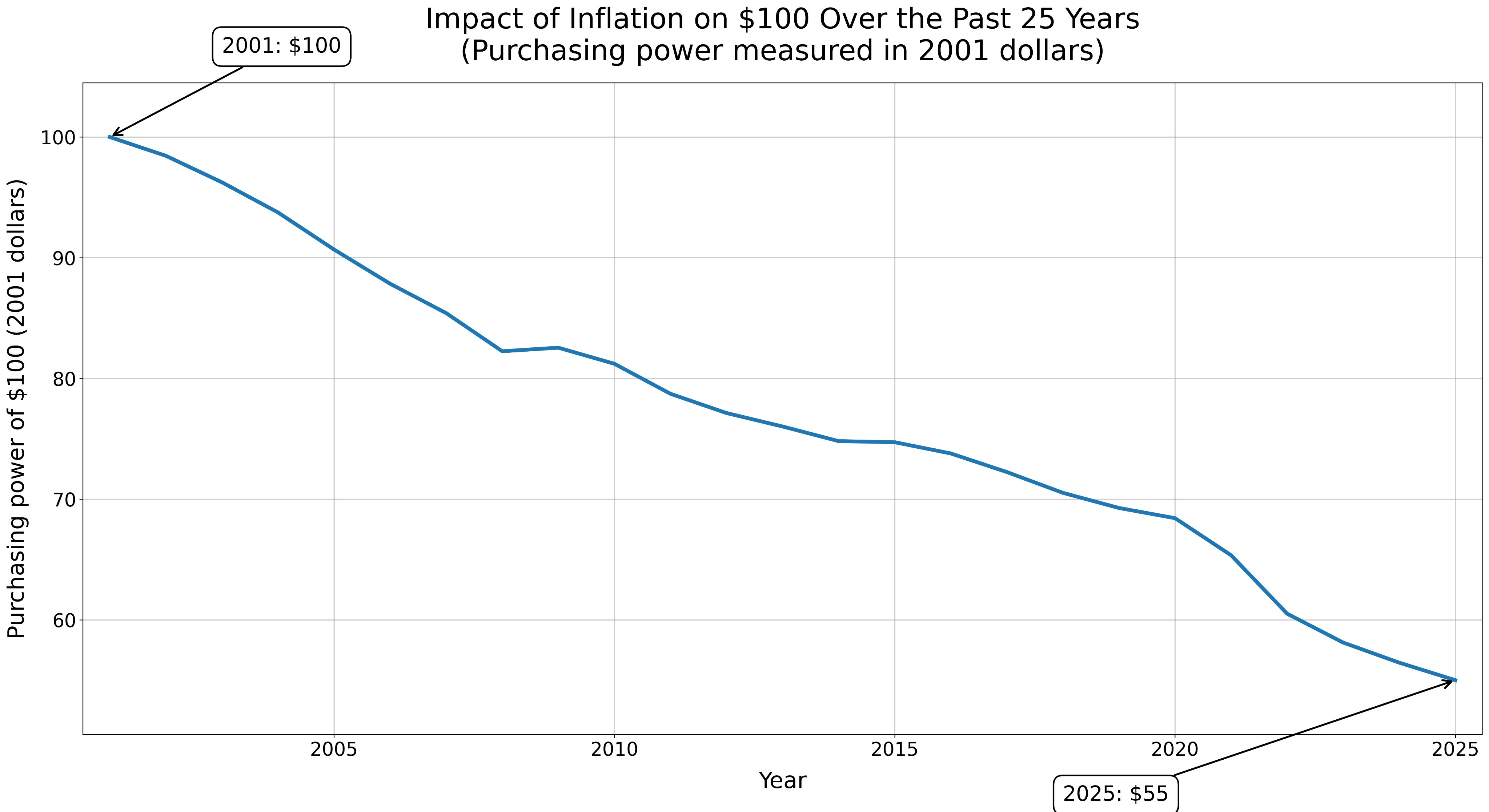
Note: Chart shows the purchasing power of $100 from 2001 measured in constant 2001 dollars, based on Consumer Price Index data. The steady decline illustrates how inflation erodes the real value of money over time.
Inflation sounds like an abstract economic term, but you feel it every time you check out at the grocery store or pay a monthly bill. The chart above tells a stark story: $100 in 2001 could only buy what $55 buys today. That’s not a typo, your money has lost 45% of its purchasing power in just one generation.
The Real Impact: More Than Just Numbers
Imagine you saved $10,000 in 2001 for a future expense. If you kept it in cash under your mattress, that money would have the purchasing power of just $5,500 today. You didn’t lose a single dollar bill, but you lost nearly half of what those bills could buy.
This is inflation in action, not just rising prices, but the steady erosion of what your money can actually purchase.
Understanding Inflation: It’s Not Just About Prices
A useful way to picture inflation is to imagine your favorite burger slowly getting smaller while the price stays the same. You’re spending the same amount but getting less in return. With inflation, the burger stays the same size, but the price rises. Either way, your purchasing power drops.
When prices increase across a wide range of everyday items, food, gas, rent, insurance, travel, and services, that’s inflation reshaping your budget in real time.
How We Measure Inflation Today
In the United States, inflation is tracked using the Consumer Price Index (CPI), produced by the Bureau of Labor Statistics. The CPI measures the average change in prices paid by consumers for a large basket of goods and services, including:
- Housing and rent
- Food and beverages
- Transportation
- Medical care
- Education
- Energy and utilities
- Apparel and household goods
Each category is weighted based on typical household spending patterns. When the total cost of this basket rises, reported inflation rises. That’s why inflation numbers are usually reported as a percentage change over the past year or month.
What the Chart Reveals About Your Money
The 25-year trajectory shown in the chart reveals several key periods:
2001-2008: Steady erosion – The purchasing power of $100 declined to roughly $83 as moderate inflation chipped away at dollar values during relatively stable economic growth.
2008-2010: Brief plateau – During the Great Recession, the decline slowed as deflationary pressures temporarily counterbalanced long-term inflation trends.
2010-2020: Gradual decline – A decade of low but persistent inflation brought $100 down to about $68 in purchasing power, a loss of roughly $1.50 per year.
2020-2025: Accelerated drop – The steepest decline occurred in recent years, with purchasing power plummeting from $68 to $55. This sharp drop reflects the elevated inflation rates that have dominated headlines and strained household budgets.
The Historical Definition: More Than Rising Prices
Today, most headlines use “inflation” to mean rising consumer prices. But historically, the term encompassed something broader, the expansion of money and credit in the economy.
The 1983 edition of Merriam-Webster defined inflation as an increase in the amount of currency in circulation, resulting in a sharp fall in its value and rise in prices, potentially caused by increased paper money, gold mining, or spending outpacing the supply of goods.
This definition highlights two connected forces: the money side (how much currency and credit exist) and the price side (how expensive goods become). Many economists still think in these terms, when money supply grows faster than the supply of goods and services, prices tend to rise over time.
Why This Matters to You
Inflation isn’t just about prices going up, it’s about your purchasing power going down. If inflation runs at 2% per year (the Federal Reserve’s target), a dollar next year buys about 2% less than today. That may not sound like much, but as the chart demonstrates, small annual losses compound dramatically over time.
Central banks target around 2% inflation as a sign of stable economic growth. But when inflation rises to 5%, 7%, or higher, as we’ve seen recently, households notice immediately. Paychecks often lag behind price increases, squeezing budgets and eroding savings.
Protecting Your Purchasing Power
Understanding inflation’s impact raises an important question: How do you protect your money from this steady erosion?
Simply holding cash means accepting the purchasing power decline shown in the chart. That’s why many people invest in assets that historically outpace inflation, stocks, real estate, inflation-protected securities, or other investments designed to grow faster than prices rise.
The key is recognizing that in an inflationary environment, standing still means falling behind.
The Bottom Line
Inflation is not just a statistic released once a month, it’s a real-world force affecting wages, savings, investments, and daily living costs. The chart’s downward slope from $100 to $55 over 25 years tells the story more powerfully than any percentage: your money is constantly losing its ability to buy the things you need.
Whether you view inflation mainly as rising prices or as growth in money and credit, the practical impact remains the same. Over time, each dollar tends to buy less. Understanding this helps you look past the headlines and make better decisions about earning, spending, saving, and investing for your financial future.
Related Posts: Tariffs 101 | Monthly Jobs Report