Last updated September 21, 2026
A startup waterfall decides who gets paid when a company sells, in what order, and how much. Your ownership percentage alone does not tell you what your shares will pay.
Founders and employees can own most of a company and still receive nothing from a sale. Debt, deal costs, and investor rights can use up the money first.
The key question is simple: after every claim ahead of your shares is handled, what is left for you?
How a startup waterfall works
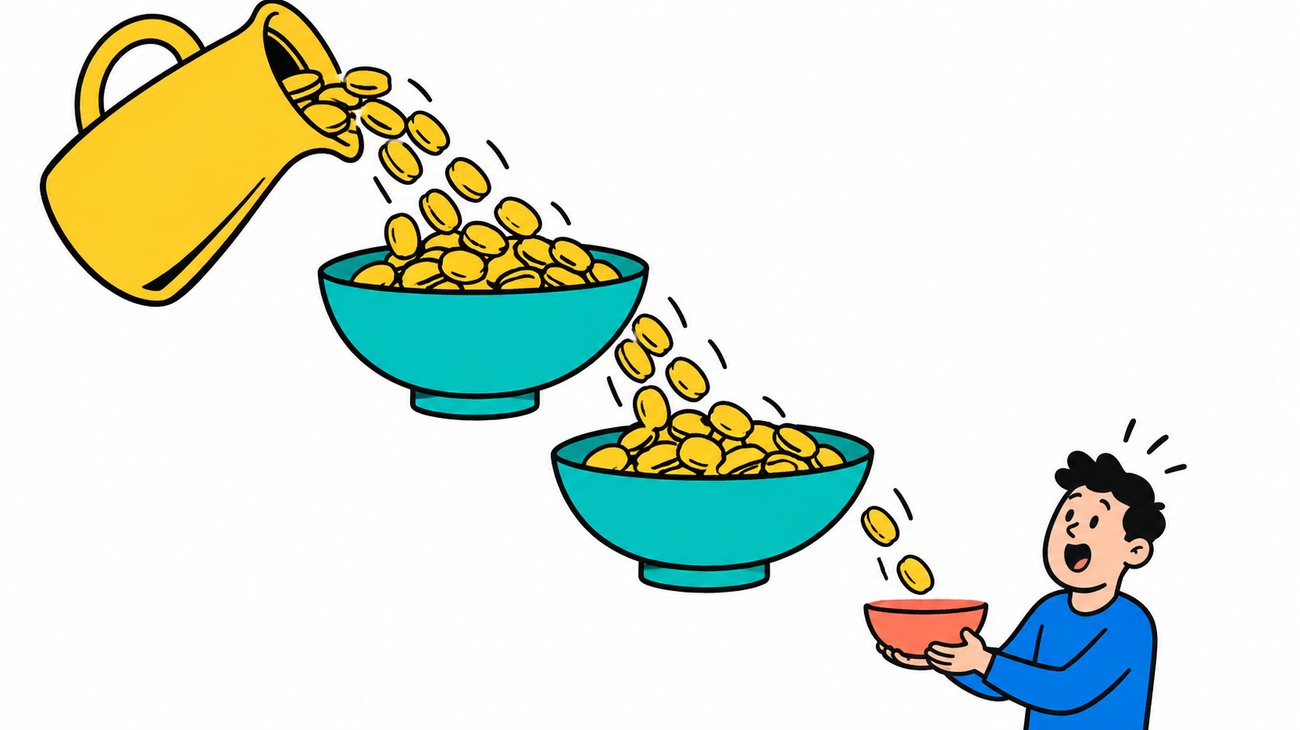
Think of sale proceeds filling a series of buckets. Higher claims get paid first. Money reaches the next bucket only if the deal terms allow it.
This guide covers a U.S. startup with preferred and common stock. An LLC can have a different payout structure. The signed documents control the result, including which sales or mergers trigger the preference.
Investors often hold preferred equity. Founders and employees usually hold common stock or options to buy it. A liquidation preference gives preferred holders a claim ahead of common. It can apply to an acquisition even when the business keeps operating.
Start with the amount available to shareholders
The headline sale price may include money that never reaches shareholders. First account for debt to be repaid, deal expenses, and any other required adjustments. These can include taxes or a change in working capital, depending on the deal.
For example, a $20 million price less $3 million of debt and $1 million in fees leaves $16 million for equity, assuming no other adjustments. Do not deduct debt again if the quoted figure already reflects it.
Secured and unsecured creditors generally rank ahead of equity. Their own payment order depends on the claims, agreements, and law. Deal fees and debt are not one universal legal tier.
Apply the preferred and common stock terms
Preferred holders may take their preference or convert their shares to common. Some preferred shares also get a share of the money left after their preference is paid.
Common holders receive the amount left for them under those rules. If the available money runs out first, their payout is zero. A preference gives investors priority, not a promise that enough cash will exist to repay them.
Three terms that change the payout
Seniority decides which investors go first
With stacked seniority, one preferred series ranks ahead of another. A Series B round might rank ahead of Series A. Later funding is not automatically senior; the documents must give it that right.
With pari passu treatment, preferred series share the same rank. If there is not enough money to pay their full preferences, they divide it under the agreed formula, often in proportion to the preference amounts owed. Those amounts may differ from dollars invested.
Suppose Series A has a $5 million preference and Series B has a $10 million preference. Only $9 million is available, and neither series converts. If B is senior, B gets all $9 million. If they rank equally and share by preference amount, A gets $3 million and B gets $6 million. Common gets nothing in either case.
The liquidation multiple sets the preference amount
A 1x preference on a $5 million investment is $5 million. A 2x preference on that investment is $10 million. Required dividends can add to the claim if the documents say so.
With $12 million available to shareholders, a 1x non-participating investor who takes its preference leaves $7 million for common. A 2x preference leaves $2 million. That one term shifts $5 million away from common.
Participation determines whether investors share twice
Non-participating preferred takes either its preference or the payout it would receive as common stock. It does not take both. With one preferred series, the choice is easy: compare the preference with its ownership share of the available proceeds.
Participating preferred takes its preference first, then shares in the remaining proceeds with common. This is the “double dip.” Cooley explains both structures in its preferred-stock guide.
Capped participation limits the total payout under that preferred path, usually including the preference itself. For example, a 3x cap on $5 million would limit that payout to $15 million. If conversion pays more, investors may convert and exceed the participation cap. Check how the contract defines the cap and conversion rights.
A startup waterfall example
Assume one investor puts in $5 million for 20% of the company on an as-converted basis, meaning after preferred converts to common. The investor holds 1x non-participating preferred. Founders and the team hold the other 80% as issued common shares.
The table starts with proceeds available to equity after debt, fees, and other adjustments. It assumes no options, other securities, dividends, or later funding rounds. Payouts are before each holder’s taxes. “M” means million.
Available to equity | Investor payout | Common payout |
$4M | $4M preference¹ | $0 |
$15M | $5M preference | $10M |
$25M | $5M either way | $20M |
$50M | $10M on conversion | $40M |
¹ The $5 million preference is limited to the $4 million available.
At $15 million, the investor takes $5 million because conversion would pay only $3 million. Common gets the remaining $10 million, about 67% of the proceeds, despite owning 80% on an as-converted basis.
The conversion breakpoint is $25 million: $5 million divided by 20%. At that amount, either path pays the investor $5 million. Above it, conversion pays more.
That shortcut works for this one-series example. With several preferred series, one series may convert while another keeps its preference. Each choice can change the pool and ownership shares used for the remaining payouts.
What changes with participating preferred
Keep the same $5 million investment, 20% stake, and $15 million in equity proceeds. Change only the terms to 1x participating preferred without a cap:
- The investor takes its $5 million preference.
- The investor also receives 20% of the remaining $10 million, or $2 million.
- The investor gets $7 million total. Common gets $8 million.
Participation moves $2 million from common to preferred compared with the non-participating example. The sale price and ownership percentages did not change.
Why the founder check can still be smaller
Options have an exercise price
An option is a right to buy stock, not an issued share. Its payout can depend on vesting, its exercise price, and how the buyer handles it. A cash-out often pays the common-share value minus the exercise price for each eligible option. Options with no positive spread may receive nothing.
An ungranted option pool is not a person owed a check. Do not give it a payout just because it appears in a fully diluted cap table.
Some proceeds arrive later or never arrive
An escrow holds back part of the price to cover claims. An earnout pays only if agreed targets are met. Buyer stock is not cash. Model what is payable at closing separately from amounts that are delayed or uncertain.
Other contracts can change the split
Unconverted SAFEs, convertible notes, warrants, and management bonus plans need their own treatment. For example, SAFEs can have sale provisions that apply before they convert in a funding round. Do not put every instrument in the common-stock bucket.
Run the waterfall before you sign
Build a payout model for a low, middle, and high exit before accepting a funding offer. Update it after each new round or loan. Include:
- The proceeds available to equity after debt, costs, and deal adjustments.
- Each series’ preference, seniority, participation cap, and conversion rights.
- Actual share counts, option terms, and other outstanding securities.
- Your own payout, plus the team’s payout, at closing and under later-payment scenarios.
Use the final charter and signed agreements, not only the term sheet. The NVCA model financing documents show the types of documents used in venture rounds, but your company’s terms determine your payout. Have counsel and your finance lead check the model against them.
A cap table shows what you own. A waterfall shows what that ownership could pay. Before you agree to the next valuation, know the exit price at which your common shares start receiving money.