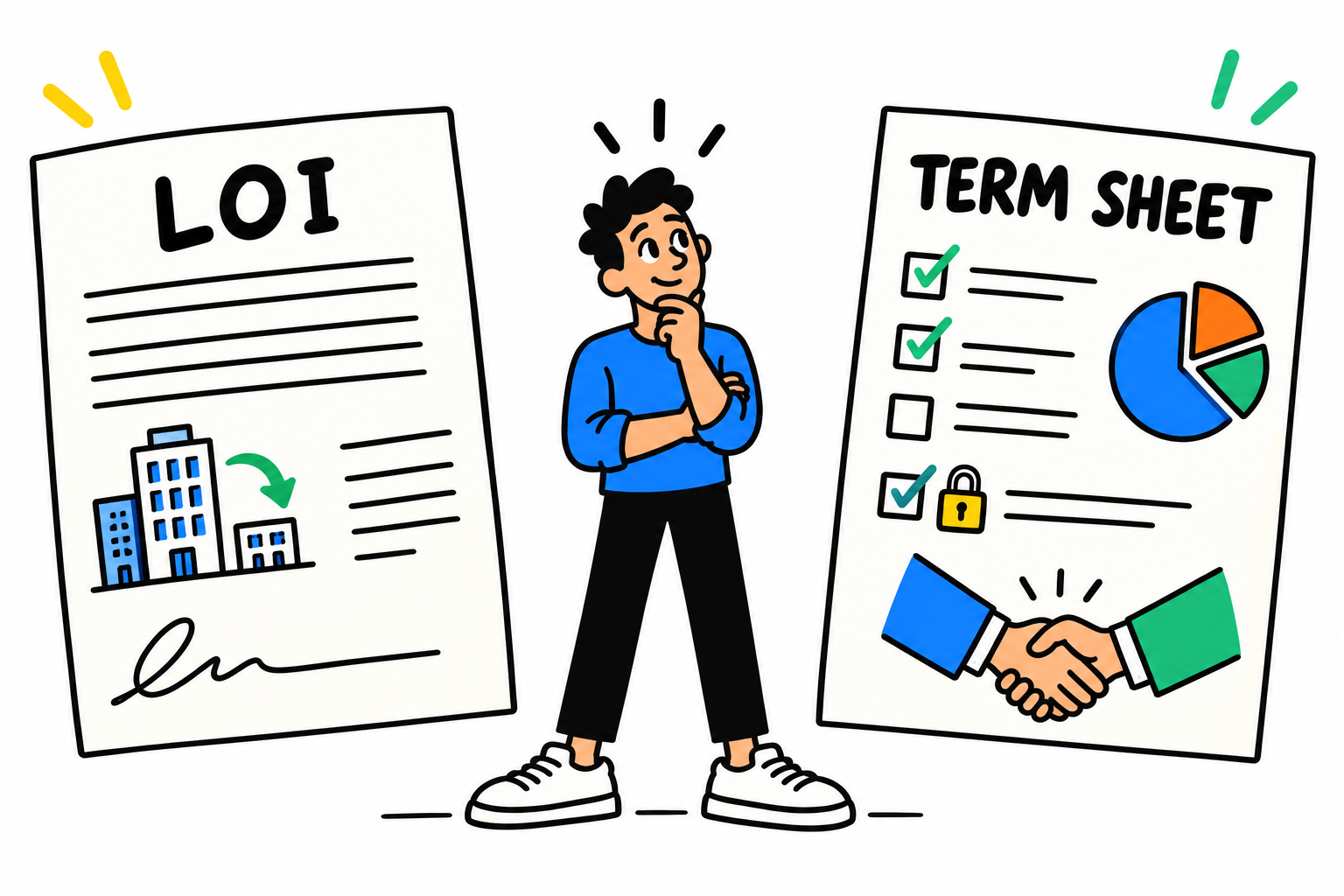
An LOI (letter of intent) and a term sheet both outline deal terms before the final contracts are written. They are not the same paper. They show up in different deals, at different times, and in different formats.
LOI vs. Term Sheet at a Glance
An LOI is a letter. A buyer in an acquisition usually writes it. It describes the deal, the price, the structure, and the steps that follow.
A term sheet is a bullet list. A lead investor usually writes it. It covers valuation, ownership, control, and investor rights.
Document Type | Letter of Intent (LOI) | Term Sheet |
Format | Formal letter, 3 to 8 pages | Bullets or a table, 1 to 3 pages |
Typical use | Buying or selling a business, asset deals, some joint ventures and real estate | VC and PE financings, priced equity rounds |
Focus | What is being bought, how it is paid, diligence, timing | Valuation, share price, preferences, board seats, option pool |
Who drafts it | Buyer or buyer’s counsel | Lead investor |
What comes next | Diligence, then a purchase agreement | Stock purchase agreement and financing papers |
Exclusivity | Common. Often 30 to 90 days. | Sometimes. Not automatic in early rounds. |
An LOI reads like a short preview of the purchase agreement. A term sheet reads like a checklist of economics and control.
When Each Document Shows Up
Sale of a business
- Early talks, a teaser, or a confidential information memo
- An indication of interest in some marketed sales
- Letter of intent
- Exclusivity and diligence, often 30 to 90 days
- Purchase agreement
- Close
The LOI is the handoff from “we might do a deal” to “we are running a process.” It is usually signed before the buyer gets full access to books, contracts, and operations.
Startup priced round
- Pitches and a data room
- Alignment on a valuation range
- Term sheet from the lead investor
- Financing documents, including a stock purchase agreement
- Close and funding
A SAFE or convertible note often skips a full-term sheet and uses a short standard form. See SAFE notes explained.
What Each Document Covers
A business-purchase LOI
- Parties
- Asset sale or equity sale
- Price and how it is paid
- Working capital or inventory
- What is included and what is left out
- Diligence access
- No-shop, meaning a pause on talks with other buyers
- Confidentiality
- Conditions to close, including financing
- Target timing
- Who pays costs if the deal ends
- Which clauses bind
A financing term sheet
- Pre-money or post-money valuation
- Amount raised and price per share
- Type of stock, usually preferred
- Liquidation preference, which sets who gets paid first in a sale
- Board seats
- Protective provisions, meaning investor veto rights
- Option pool size, and whether the pool is set before or after the new money
- Pro rata and information rights
- Sometimes a no-shop while papers are drafted
The LOI spends more space on process and what transfers. The term sheet spends more space on ownership and control.
What Binds and What Does Not
Neither paper usually forces the parties to close the final deal.
Price, valuation, structure, and closing conditions are usually non-binding. Diligence can change them. The final contracts can change them again.
These items often bind on signing: confidentiality, exclusivity or no-shop, cost allocation, and governing law.
The title does not decide that split. The words in the paper do.
Papers That Sit Nearby
- Indication of interest (IOI): earlier and lighter than an LOI. Often just a price range.
- Memorandum of understanding (MOU): broader. More common for partnerships than for a clean sale or priced round.
- SAFE or convertible note: the investment contract itself at pre-seed and seed. See SAFE notes explained.
- Purchase agreement or stock purchase agreement: the later binding contract.
The LOI also sits inside the buy-a-business path described in entrepreneurship through acquisition. Company size changes who shows up after that paper. See why bigger companies are harder to sell.
The Difference That Holds
Call it an LOI when the next step is diligence on an operating business. Call it a term sheet when the next step is a financing that changes the cap table.
One is a letter that frames a sale and a process. The other is a summary that frames economics and control. Both record early terms. Neither is the final deal.