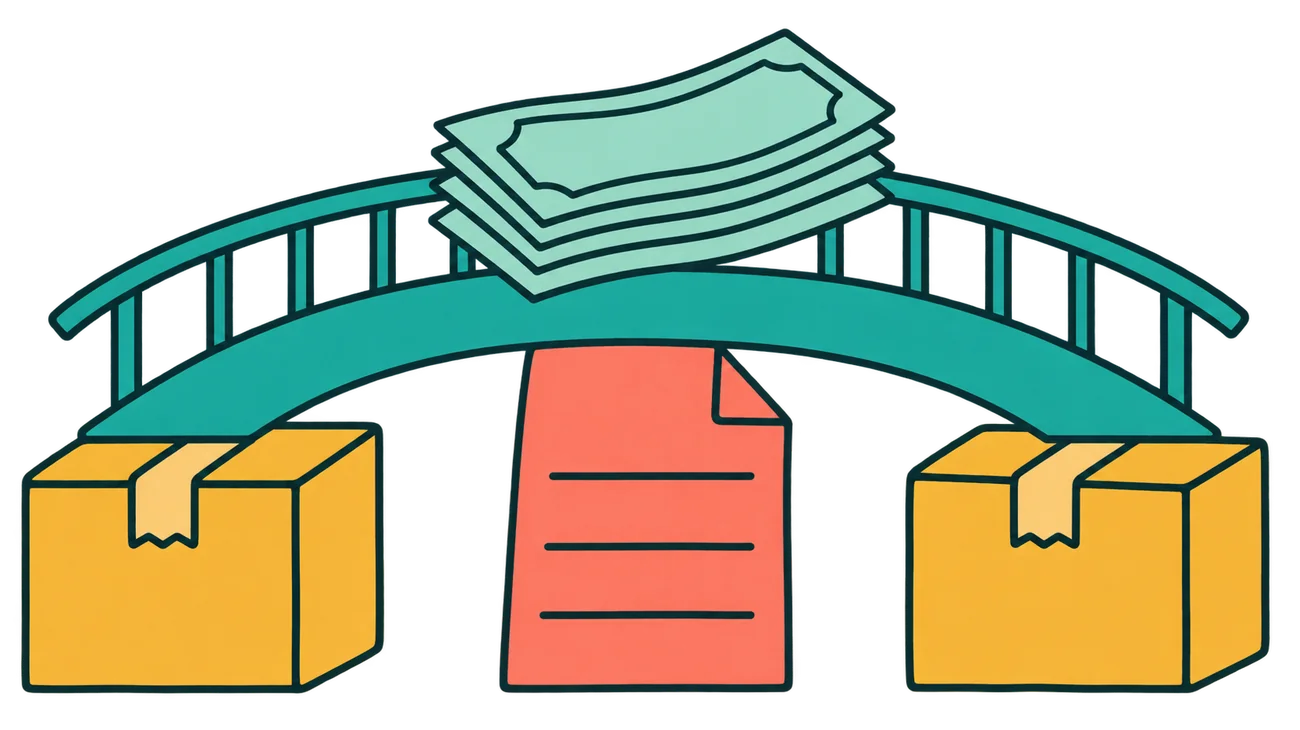
Asset-based lending lets your business borrow against assets it owns, such as unpaid customer invoices, inventory, or equipment. It can help cover bills while cash is tied up in those assets.
The catch: what you can borrow changes with the assets that qualify. A large credit limit does not mean all that money is available today.
How Asset-Based Lending Works
Most asset-based loans use a revolving line: draw money, repay it, and borrow again within the agreement’s limits. Some also include a term loan, as Wells Fargo’s asset-based lending overview explains.
The lender decides which assets qualify, then applies an advance rate. This is the share of each asset’s eligible value it will lend against. Those amounts, less any reserves the lender holds back, form the borrowing base.
Your borrowing base is not the same as your credit limit. You can generally borrow up to the lower of the two, minus what you already owe and any other required deductions.
For the basics of drawing and repaying funds, see our guide to business lines of credit.
Which Assets Qualify
Accounts receivable are unpaid customer invoices. Lenders want bills customers are likely to pay. Old or disputed invoices may not count. Too much owed by one customer can also limit borrowing.
Inventory must have resale value. Slow-moving, damaged, or custom-made goods may qualify for less or nothing. Ask whether the lender uses inventory cost or an appraiser’s estimate of resale proceeds. The same advance rate can produce very different loan amounts.
Equipment may also qualify. Its value to the lender depends on what it could sell for, not what you paid for it. Some deals finance equipment through a separate term loan.
An inspection of your records and assets helps set these terms. Bank of America’s ABL guide explains why asset quality and appraisals matter. There is no single advance rate that applies to every borrower.
A Simple Borrowing Base Example
Suppose a business has a $250,000 credit limit, $200,000 in eligible invoices, and $100,000 in eligible inventory. The lender agrees to the following rates.
| Asset | Eligible value | Advance rate | Loan support |
|---|---|---|---|
| Customer invoices | $200,000 | 80% | $160,000 |
| Inventory | $100,000 | 50% | $50,000 |
| Total | $300,000 | $210,000 |
Illustration only. Assumes no reserves, other credit use, or added fees. Rates are not lender quotes.
The borrowing base is $210,000, so the business cannot draw the full $250,000 limit. After a $120,000 draw, it has $90,000 left to borrow, assuming nothing else changes.
Now suppose some invoices stop qualifying and the base falls to $100,000. With $120,000 still owed, the business is $20,000 over the base. The agreement may require a prompt repayment or other steps to fix that shortfall.
When Asset-Based Lending Fits
It can suit wholesalers, manufacturers, retailers, and other businesses with assets that turn into cash. It may help fund seasonal stock or growth that ties up cash before customers pay.
A business with few assets, weak records, or a small funding need may find the reporting and fees hard to justify. If you need one machine or vehicle, compare equipment financing first.
Cash-flow loans focus more on the business’s ability to repay from earnings. They can also require collateral. Asset-based lending puts more weight on the assets, but lenders still review the business and its finances. It is not automatic approval for poor credit.
Costs and Controls to Check
Interest generally applies to the balance you draw. That does not mean an unused line costs nothing. Ask for all charges, including setup, unused-line, appraisal, field-exam, account-control, and exit fees.
The OCC’s asset-based lending handbook explains the added costs and controls, including the risk of losing access to cash when the borrowing base falls.
For a simple cost test, assume a $120,000 balance at a 12% annual rate for 30 days. On a 365-day basis, interest is about $1,184. Add a hypothetical $500 monthly fee, and the cost becomes $1,684. This is an example, not a market quote; it excludes setup and other charges.
If you default, the lender can seek repayment from pledged assets. A personal guarantee, if required, can also put your own finances at risk.
Budget for your own work, too. Ask how often you must send invoice aging reports, inventory records, and borrowing base reports, and who will prepare them.
Asset-Based Lending vs Factoring
With asset-based lending, you borrow against invoices. With factoring, you sell them. Wells Fargo’s factoring overview describes that sale structure.
Do not assume the product name tells you who handles collections. Check who contacts customers, where payments go, and who bears the loss if a customer fails to pay. An asset-based lender may require payments into an account it controls.
Questions to Ask Before You Sign
- Which assets qualify, how are they valued, and what reserves apply?
- What must I do if the borrowing base falls below what I owe?
- What is the total cost at my expected balance, including fees?
- Who controls customer payments, and when can I access the cash?
- Do you require a personal guarantee or a claim on other business assets?
- Can I sell inventory in normal business operations or take on other debt?
- When does the line mature, and what does renewal or early exit cost?
Have your accountant check the numbers and your attorney review the agreement. Compare the cash available after fees and reserves, not just the headline limit. Leave room for late customers and slower sales before deciding how much to draw.