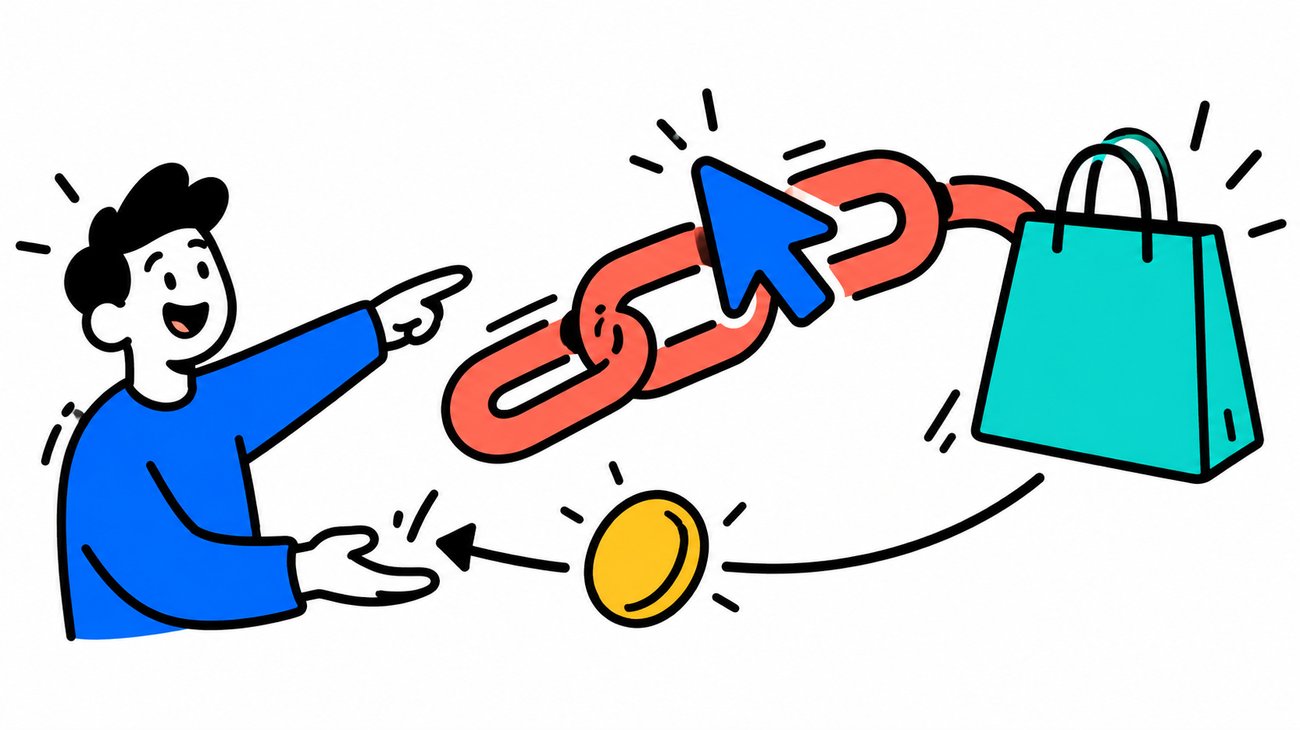
Affiliate marketing lets you earn money by recommending another company’s products. It also lets you pay partners to bring customers to your business. In both cases, the commission depends on a tracked sale, lead, or other agreed action.
For an owner who already shares useful tools with customers, becoming an affiliate can be a small test. Running your own program takes more work. You need room in your margins, reliable tracking, and partners who reach the right buyers.
How affiliate marketing works
The affiliate promotes an offer through a tracking link or code. The merchant sells the product and pays the commission. A network or software platform may handle tracking and payments.
For example, a web designer recommends a hosting service. A client uses the designer’s link and buys a qualifying plan. Once the sale is approved, the designer earns a commission.
There are two ways to use the model:
• Become an affiliate. Recommend other companies’ products to your readers, customers, or followers. You earn commissions without handling those products’ orders or shipping.
• Run an affiliate program. Recruit partners to promote your products. You pay for approved results and remain responsible for filling orders and serving customers.
A commission may be a fixed amount, a share of the sale, or a recurring payment. Recurring does not always mean forever. Payments may stop after a set period, when the customer cancels, or under other program terms.
When it makes sense for your business
Becoming an affiliate fits best when people already come to you for advice. A bookkeeper might recommend software. A repair shop might recommend tools. The offer should solve a problem your audience already has.
A large following is not required. You do need people who trust your advice and have a reason to buy. Ten useful recommendations can matter more than thousands of views from the wrong audience.
For merchants, commissions can tie part of the marketing bill to results. But the channel is not free until a sale happens. Software, samples, staff time, and any upfront partner fees still cost money.
How to start as an affiliate
Start with three to five products you can recommend with a clear reason. Explain what each does well, who it fits, and where it falls short. Do not claim you used something if you did not.
Check the company’s website for an affiliate or partner program. You can also explore Amazon Associates for products, Awin for brand programs, and the PartnerStack marketplace for business software. These are places to research, not guarantees of approval or earnings.
Older guides may list ShareASale. Awin says ShareASale closed on October 6, 2025, so use Awin for current options.
Before joining, check five things:
1. What pays. Is it a purchase, paid subscription, or qualified lead? A free trial may not earn anything.
2. How much pays. Check the rate, eligible products, exclusions, and how long recurring payments last.
3. Who gets credit. The attribution window is how long a referral can qualify. A later click on another partner’s link may change who earns the commission.
4. When cash arrives. Check approval delays, payout thresholds, and whether refunds cancel commissions.
5. Where links are allowed. Follow rules for email, social posts, paid ads, discount codes, and brand names.
Then publish one useful piece of content. Try a product comparison, setup guide, or resources page. Explain the choice before asking for the click.
How much could you earn
Use a simple example, not an income promise. Suppose 200 people click your link, 4% become approved paying customers, and each earns you $25. That is eight customers and $200 in commission revenue.
Your earnings depend on relevant clicks, approved conversions, and the commission per conversion. Subtract content costs, tools, and paid promotion to see whether the work pays. Also consider your time.
Review clicks, approved sales, and cash received after 30 to 60 days. A small sample or a long buying cycle may need more time. Pending commissions are not money in the bank.
How to launch your own affiliate program
Start with an offer that already sells. An affiliate program will not fix a product people do not want or a checkout that loses buyers.
Work out your contribution margin before setting the commission. That is what remains after the costs that rise with each sale. Your payout needs to leave enough to cover overhead and profit.
Here is an example of a $100 order with no discount or return. Sales tax is excluded. These figures illustrate the math, not an industry benchmark.
| Per order | Amount |
|---|---|
| Revenue | $100 |
| Product cost | −$40 |
| Shipping and fulfillment | −$10 |
| Payment processing | −$3 |
| Affiliate commission at 15% | −$15 |
| Remaining before other costs | $32 |
The $32 still has to cover any other costs, including program fees, returns, overhead, and profit. A discount reduces that cushion. Run the math again with the actual discounted price and commission rules.
Then build a small program:
1. Define the payout. State which sales qualify and whether commissions exclude discounts, shipping, tax, and returns.
2. Set the rules. Cover tracking windows, payout timing, refunds, self-referrals, coupon use, and paid ads using your brand name.
3. Test tracking. Use your platform’s test process to confirm links, codes, purchases, and refunds record correctly.
4. Recruit a few partners. Start with customers or businesses whose audiences fit. Give them accurate product details and clear disclosure instructions.
5. Review each partner. Check approved sales, refunds, customer quality, and margin after all program costs.
Do not confuse credited sales with new sales. A coupon site may collect a commission from someone who was already about to buy. Look at new-customer share and whether a partner brings demand you would otherwise miss.
Disclose affiliate relationships clearly
The FTC’s endorsement guidance says people should understand when you are paid for a recommendation. Put a clear disclosure where they will see it with the recommendation and link. A buried policy page is not enough.
For example: “I may earn a commission if you buy through links in this post.” Add “at no extra cost to you” only if that is true.
A short disclosure near the beginning may work for a short post. Longer posts may need disclosures repeated near recommendations. The words “affiliate link” alone may not explain that you get paid.
For video, disclose within the video, not just in the description. For social posts, do not hide the disclosure behind a “more” button. Follow any extra wording the program requires. If you run a program, train partners and monitor their claims and disclosures.
Mistakes that cost trust and money
• Choosing the biggest payout over the best fit. A weak recommendation can cost more trust than it earns in commissions.
• Assuming every referral will track. Browser settings, device changes, and another partner’s link can affect credit. Learn the program’s rules.
• Counting pending commissions as final. Refunds, fraud checks, and rejected leads can reduce the payout.
• Leaving old advice online. Products, prices, and program terms change. Review pages that keep sending traffic.
• Scaling before the math works. More clicks or sales do not help if the costs eat the return.
Start with one useful recommendation
Pick a product that fits your audience, read its program terms, and publish one helpful recommendation with a clear disclosure. Track approved commissions and the time it takes to earn them.
If you sell your own product, test a few partners with a payout your margins can support. Expand when those partners bring customers worth paying to acquire.